Burnout in Remote Teams Is a Leadership Issue, Not a Work Model Issue
By: Cynthia Claridge
The Misdiagnosis of Remote Work Burnout
Remote work did not create burnout. It revealed it. For years, traditional office environments masked leadership gaps through proximity. Managers relied on visibility, informal check-ins, and physical presence to maintain alignment. When work shifted to distributed environments, those same habits stopped working.
What emerged wasn’t a failure of remote work. It was a failure to adapt leadership practices to a model that requires greater intentionality.
In remote settings, performance is no longer sustained by observation. It depends on clarity, trust, and structured communication. These areas were underdeveloped by many organizations long before the shift to remote work.
Why Burnout Persists in Remote Teams
Burnout in remote environments is often misattributed to workload. In reality, it is more frequently driven by structural and leadership deficiencies, including:
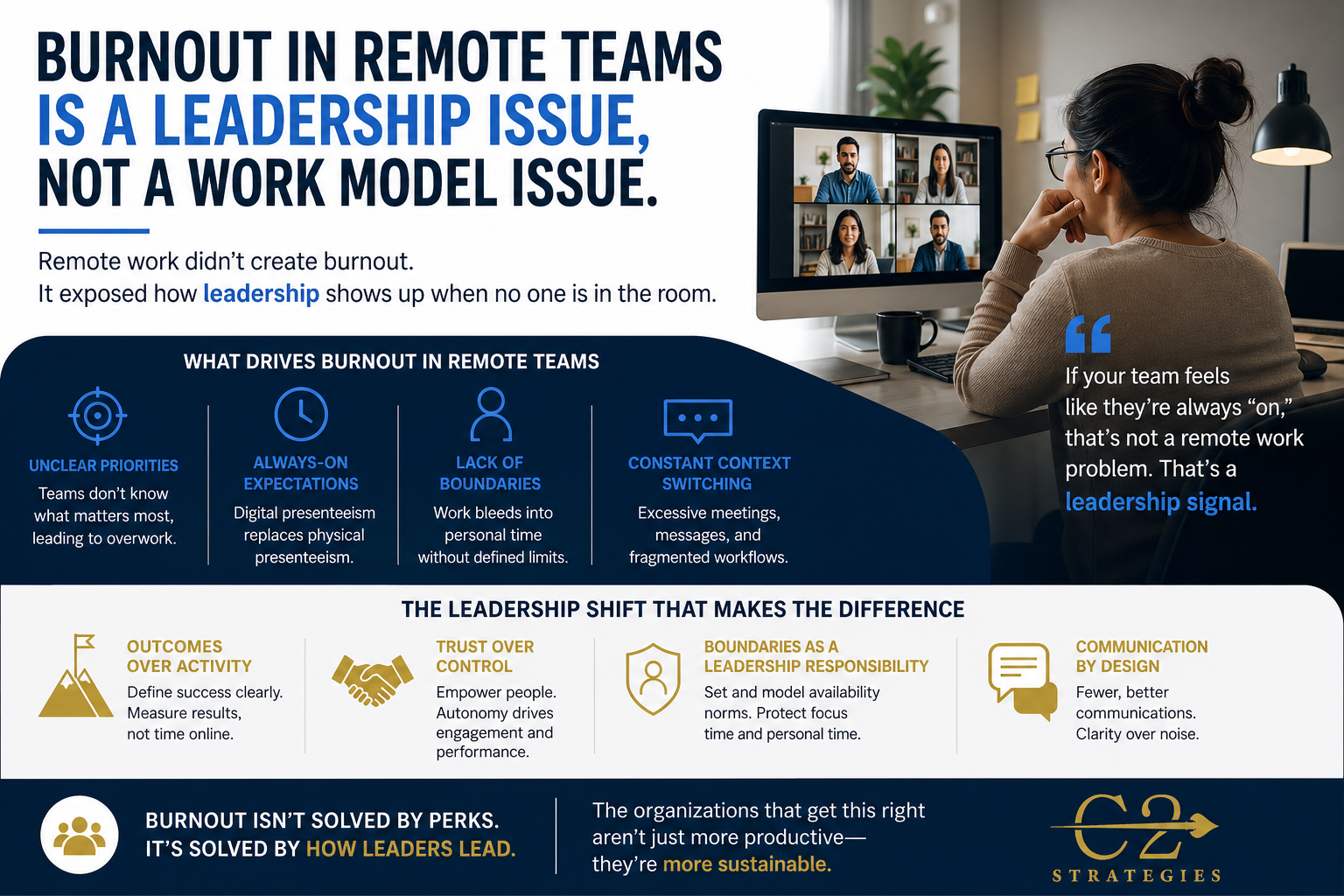
- Unclear priorities. When leadership fails to provide a clear mission, vision, and priorities, teams do not understand the company's direction. Teams don’t know what matters most, leading to overwork.
- Always-on expectations. Always-on expectations often replace one problem with another. Digital presenteeism replaces physical presence. I’ve seen this firsthand. I worked under a leader who expected everyone to be active on Teams at all times. If your status light wasn’t green, the assumption was simple: you weren’t working. What should have been flexibility became constant surveillance. An environment defined by oppressive oversight and continuous monitoring rather than by trust and outcomes.
- Lack of boundaries. Work doesn’t just extend; it bleeds into personal time when there are no clearly defined limits. In remote environments, the line between “available” and “expected to respond” becomes blurred. Without intentional guardrails from leadership, employees begin to fill the gaps by answering late messages, joining unnecessary calls, and staying online longer than needed just to signal engagement. What starts as flexibility quickly turns into unspoken pressure to always be accessible. Over time, this erodes recovery time, increases fatigue, and creates a cycle where disconnecting feels like falling behind.
- Constant context switching. Excessive meetings, nonstop messages, and fragmented workflows force employees to repeatedly shift focus throughout the day. Instead of deep, meaningful work, time gets consumed by reacting, such as jumping from calls to chats to emails with little continuity. Each interruption carries a cognitive cost, reducing efficiency and increasing mental fatigue. In remote environments, where everything is digital, this becomes even more pronounced. Notifications disrupt natural workflow, and without structure, the workday becomes a series of disruptions rather than sustained progress. Over time, constant context switching doesn’t just slow productivity. It accelerates burnout by keeping people busy, but rarely effective.
In a fully digital environment, these issues don’t just exist; they amplify.
A 2021 study published in Nature Human Behavior (Yang et al.) found that remote work increased the length of the workday and the frequency of meetings, contributing to cognitive overload. Similarly, Harvard Business Review (2020) reported that employees experienced higher levels of exhaustion due to blurred work-life boundaries and increased communication demands. Burnout, in this context, is not accidental. It is systemic.
The Leadership Shift Remote Work Requires
Effective remote leadership is not a digital version of office management. It is a fundamentally different discipline.
High-performing remote organizations operate on a different set of principles:
1. Outcomes Over Activity
Leaders must define success clearly and measure results, not time online or responsiveness.
- Clear deliverables reduce ambiguity
- Defined priorities prevent overextension
2. Trust Over Control
Micromanagement does not scale remotely. Trust becomes a performance multiplier.
- Autonomy increases engagement (Deci & Ryan, Self-Determination Theory)
- Psychological safety improves decision-making and innovation
3. Boundaries as a Leadership Responsibility
Boundaries are not a personal productivity hack; they are an organizational design choice.
- Leaders must model and enforce availability norms
- Teams need clarity on when work starts and stops
4. Communication by Design, Not Default
More communication is not better communication.
- Intentional communication reduces noise
- Structured channels prevent constant interruptions
A 2022 study in the Journal of Applied Psychology found that poorly structured digital communication is a key predictor of employee fatigue and burnout in remote teams.
Burnout as a Leadership Signal
If a remote team feels like it is always “on,” the issue is not the work model.
It is a leadership signal.
Burnout indicates:
- Misaligned expectations
- Poorly designed workflows
- Lack of clarity at the top
Leaders set the conditions under which work happens. In remote environments, those conditions are more visible and more consequential.
The Business Case for Getting This Right
Organizations that adapt their leadership approach to remote work don’t just reduce burnout. They will gain a competitive advantage.
They see:
- Higher productivity through focused work
- Lower turnover due to sustainable workloads
- Stronger engagement driven by autonomy and trust
A 2021 report from Gallup found that employees who feel clarity in expectations and autonomy in execution are significantly less likely to experience burnout and more likely to remain with their organization.
Sustainability, not intensity, is what drives long-term performance.
Final Thought
Burnout is often treated as an employee problem to solve with wellness programs, perks, or resilience training. But the evidence points elsewhere. Burnout is not solved by what organizations offer. It is solved by how leaders lead. Remote work didn’t break teams. It exposed where leadership needed to evolve. And for organizations willing to make that shift, the opportunity isn’t just to reduce burnout. It is to build a more effective, modern, and resilient way of working.
Reference
Yang, L. et al. (2021). The effects of remote work on collaboration among information workers. Nature Human Behaviour.
Harvard Business Review (2020). How to Combat Zoom Fatigue.
Deci, E. L., & Ryan, R. M. (2000). Self-Determination Theory and the facilitation of intrinsic motivation. American Psychologist.
Journal of Applied Psychology (2022). Digital communication overload and employee fatigue.
Gallup (2021). State of the Global Workplace Report.